
One-way orientation
Keep every unit facing the same way to strengthen upward, traveling, or growing movement.
ARTWORK FORM · 02 / 05
Motifs create a decorative whole through repetition or a clear arrangement. A seamless repeat needs its own edge check.
VISUAL FORMS · 66
Compare how motif orientation follows one-way, alternating, rotating, radial, curved, or directional movement within a designed field.
Keep every unit facing the same way to strengthen upward, traveling, or growing movement.

Alternate upright and inverted units to create a rhythm of opposing vertical directions.

Cycle units through four orientations so the pattern has no single dominant reading direction.

Distribute units at many angles to avoid orderly lines and support viewing from every direction.

Turn each unit along a circular tangent like fish or leaves circulating around a center.

Aim units toward one center, or reverse them outward, to create convergence or expansion.
Compare motif sequences through alternation, cycles, main-and-filler beats, pairs, clusters, size changes, mixed scales, and even spacing.
Alternate two unit types in an ABAB order, using shape or color differences to establish rhythm.
Cycle three or more unit types in a fixed order to create a longer repeating beat.
Repeat a large main unit with smaller filler elements so the pattern retains a clear hierarchy.
Pair two matching or related units first, then repeat the pair instead of isolated single elements.
Assemble small elements into bouquets, fruit clusters, or object groups before repeating each cluster.
Alternate large and small units so scale difference, rather than shape difference, creates the beat.
Mix several sizes of the same element to suggest depth and increase visual richness.
Treat consistent open intervals as part of the rhythm, keeping every unit clearly independent.
Compare spatial gradients produced by changing motif density, scale, direction, color, or the concentration of surrounding space.
Leave generous gaps between a few units for a light, quiet pattern across the full area.
Pack elements closely, allowing local overlaps so the ground color becomes secondary.
Change the number of elements per area gradually to move from sparse to dense or back again.
Increase or decrease unit size along one direction to suggest advance, distance, or dispersal.
Change each unit’s rotation progressively to create a turning, twisting, or flow-field effect.
Keep the layout stable while grading unit color, value, or saturation through a transition.
Place a dense concentration beside a quiet open zone to create a clear visual center of gravity.
Compare scatter systems by how randomness is constrained through balance, zones, clusters, paths, overlaps, and deliberately reserved clear space.
Avoid visible rows while controlling spacing and visual weight so the overall scatter remains balanced.
Randomize placement only after limiting angle, scale, minimum spacing, and element proportions.
Give different regions distinct elements or densities, with readable zones and naturally softened edges.
Gather elements into local groups, then scatter those clusters across the field instead of spacing everything evenly.
Scatter elements along an invisible arc, wave, or route so the field carries directional flow.
Allow scattered elements to overlap, using occlusion to create depth and a sense of accumulation.
Keep elements away from wording, subjects, or selected silhouettes so reserved space shapes the pattern.
Compare how recognizable thematic motifs are mixed, bundled, scattered, linked, or grown into coherent decorative arrangements.
Combine several objects from one theme, such as baking or travel tools, then scatter the complete set.
Assemble flowers and leaves into complete bouquets before repeating or scattering each bouquet.
Preserve the natural connection of local stems, leaves, and blooms in separately scattered sprigs.
Fill the field with a branching, turning vine framework and grow small flowers along it.
Build miniature scenes from architecture, landscape, and trees, then distribute them in varied directions.
Repeat small scenes of people, animals, or daily activity so each unit carries a miniature story.
Mix words, letters, numbers, and figures, using size, direction, and spacing to establish rhythm.
Treat badges, labels, seals, or signs as complete units in a collectible-sticker pattern.
Compare continuous fields formed by parallel lines, contours, halftone dots, grains, cloud-like patches, or fluid swirls.
Fill the field with many parallel lines, using line width and fixed or changing gaps for rhythm.
Offset multiple curves from one another like contours, growth rings, or topographic lines.
Use dot size, density, and arrangement to create value, shape, or regular texture.
Cover the field with fine grains, short strokes, or fibers whose repetition remains subtle.
Fit irregular color patches or soft contours together into a cloudy, mottled full-field surface.
Bend and curl curves or color bands along a flow field to suggest vortices or liquid movement.
Compare established geometric and textile motifs by their unit shape, directional repeat, weave association, and characteristic visual rhythm.
Vary dot diameter, row alignment, offsets, and spacing to create distinct polka-dot effects.
Cross horizontal and vertical bands into checks, varying band width, grouping, and color.
Interlock pointed light and dark units into the continuous broken-check effect of houndstooth.
Alternate the direction of short diagonal segments to form a continuous herringbone rhythm.
Repeat V-shaped lines or bands, using equal widths or deliberate thick-thin variation.
Decorate curved teardrop or comma-shaped motifs internally, then scatter or interlace them.
Overlap and continuously link circles, creating petal- or lens-shaped spaces at intersections.
Build a continuous hexagonal lattice and place small floral, geometric, or symbolic motifs inside.
Combine slender diamonds and triangles around six-way centers into a pointed-leaf geometric repeat.
Compare traditional ornaments through blossom scale, intertwined vines, scrolling foliage, cloud and wave forms, and heraldic floral structure.
Repeat small flowers and leaves densely or sparsely, keeping any single bloom from dominating.
Use large flowers as focal points and support them with leaves and smaller blooms.
Link flowers and leaves with continuously curving vines that cycle across the full field.
Build a flowing structure from curled foliage, spirals, and S-shaped lines.
Form separate or connected units from curled cloud heads and wish-fulfilling-cloud curves.
Use wave crests, foam, or repeated arcs in horizontal bands or an overlapping full-field sea.
Pair plants, crowns, or objects around a center axis to create a formal heraldic unit.
Compare animal markings and natural surface patterns as recognizable motifs, including camouflage, marble veins, and wood grain.
Combine irregular rosettes, solid small spots, and ground color while varying spot size and density.
Branch, narrow, and bend dark and light bands into strongly directional natural zebra stripes.
Arrange sharp stripes with strong width variation along an implied body direction, avoiding uniform parallels.
Contrast large solid irregular patches with broad open ground, emphasizing every patch contour.
Offset tightly packed scale units, varying local color and size to build snakeskin depth.
Interlock and scatter several color patches, breaking the overall silhouette through contour and scale changes.
Combine flowing color bands, branching fine veins, and broad transitions into a marblelike pattern.
Use aligned fibers, knots, and nested curves to depict longitudinal wood grain or cross-cut growth rings.
VISUAL FORMS · 48
Compare four repeatable surface organizations whose units tile continuously beyond every edge without revealing a finite endpoint.

Place icons evenly in aligned rows and columns, adding small fillers when extra richness is needed.

Offset icons diagonally to create an interlocking rhythm, with color or size changes adding depth.

Scatter icons at varied sizes and angles with dots or similar fillers for a relaxed, spontaneous repeat.

Center icons inside diamonds, rounded squares, flowers, or other geometric cells to create an orderly decorative array.
Compare repeat lattices by grid shape and row offset, keeping each unit compatible with uninterrupted edge-to-edge tiling.
Place one unit in each equal square cell with rows and columns aligned precisely.
Use unequal horizontal and vertical spacing to create a stretched rectangular rhythm in the chosen direction.
Set units on diamond grid points so the repeat follows crossing diagonal paths.
Tilt the whole grid and align units along two diagonal axes for a strong directional flow.
Shift every neighboring row horizontally by half a unit, joining the repeat like brickwork.
Shift neighboring columns vertically by half a unit to weaken obvious horizontal rows.
Offset rows or columns by fixed thirds or quarters, returning to alignment after several steps.
Advance each row by the same distance to create a stepped diagonal channel through the repeat.
Compare seamless repeats generated by reflection and rotation, focusing on the symmetry operation that produces the continuing tile.
Mirror paired units across a vertical axis so they face toward or away from one another.
Flip units above and below a horizontal axis to form reflections, opposing pairs, or joined edges.
Rotate one unit halfway around a center to create an oppositely oriented positional pair.
Arrange units in four directions around a center, then repeat the complete rotational cluster.
Organize six directions around a center to produce a petal, snow-crystal, or honeycomb rhythm.
Mirror a unit, then translate it along the reflection axis to alternate continuously within a band.
Flip and rotate one patch into a larger repeat whose shared edges create additional shapes.
Reflect one sector across several axes to generate a compound radial kaleidoscope.
Compare seamless lattices and containers that assign motifs to repeating cells, from checks and honeycombs to nested geometric frameworks.
Alternate two colors, textures, or figures in neighboring cells to create a crisp checkerboard rhythm.
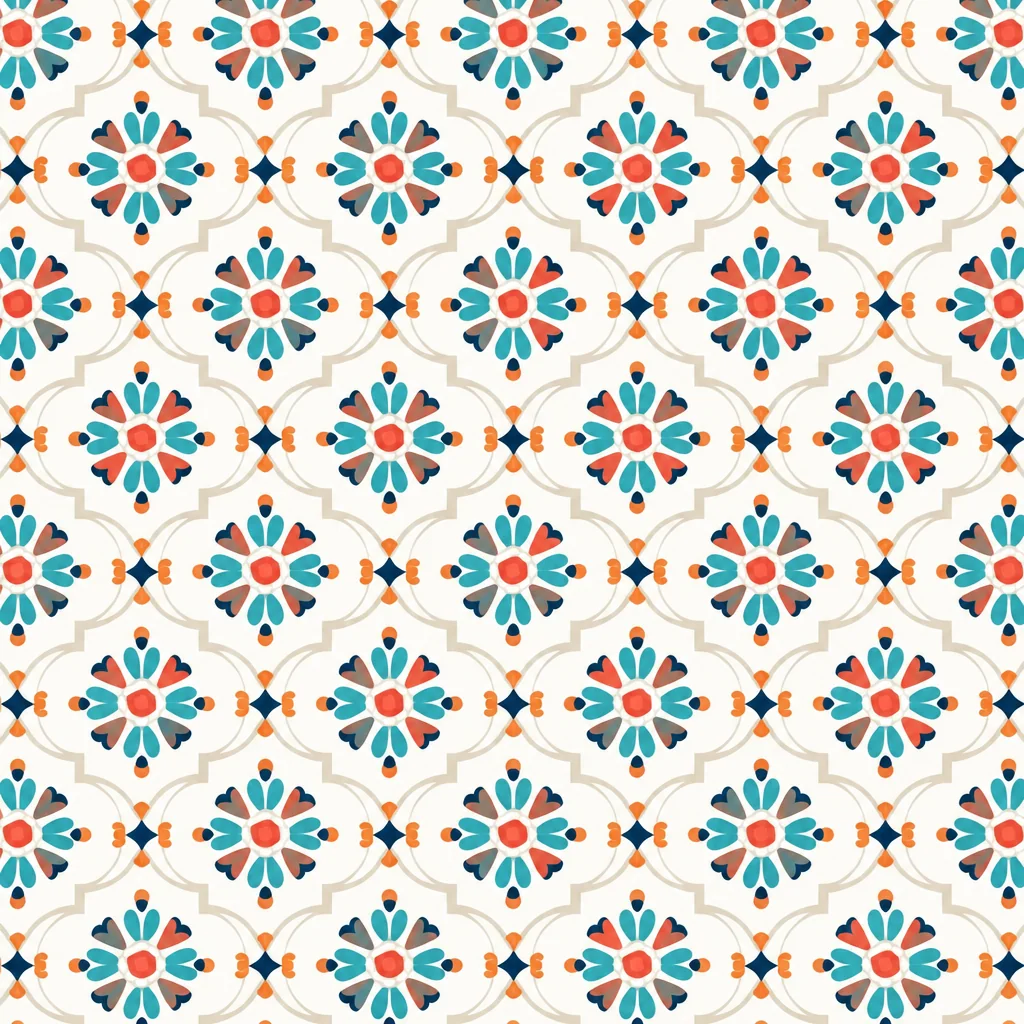
Surround center motifs with continuous diamond cells, separating the structural lattice from its decoration.
Join repeated units through a hexagonal framework so motifs correspond to the honeycomb cells.
Tile flipped triangular units, assigning different motif directions inside adjoining cells.
Combine octagons with small squares or other fillers to create primary and gap cells.
Link four-petal or quatrefoil outlines into a soft continuous lattice with open central spaces.
Overlap groups of arches to create a continuous sequence of gateways or niche-shaped spaces.
Layer and offset fans or arcs into a continuous scalloped structure resembling scales.
Repeat square or polygonal tiles whose interior designs join across edges into larger continuous figures.
Compare continuous joins and interlocks whose lines or motifs cross tile boundaries to form uninterrupted woven, linked, or maze-like surfaces.
Use one main branch as a continuous framework, growing flowers and leaves across every repeat segment.
Attach units along a periodic wave to create a gently rising and falling continuous rhythm.
Link units with an unbroken angular line that creates zigzag, return, or mountainlike movement.
Turn lines repeatedly along right-angled or winding routes to form an endlessly extensible channel.
Loop separate rings through one another to create a chainlike interlocked network.
String beads, pendants, and small figures along lines or chain segments in a clear repeating rhythm.
Weave two or more bands over and under one another according to a consistent crossing rule.
Connect a line network through knots or nodes, making both junctions and openings part of the pattern.
Compare seamless band systems by direction, curvature, spacing, internal pattern, and the visual relationship between neighboring stripes.
Run parallel horizontal bands across the field, keeping a fixed rhythm between decorated strips.
Repeat upright vertical bands suited to climbing plants, elongated motifs, or other tall themes.
Send parallel bands across the field at one fixed angle to create strongly directional channels.
Curve the bands in gentle waves and align each unit with the band’s changing direction.
Alternate two or more band types, assigning each its own figures, colors, or decoration.
Place fine stripes or small motifs inside wider bands to create a nested hierarchy.
Offset neighboring wave bands so peaks and troughs fit together continuously.
Compare edge-matched units and positive-negative relationships that continue as interlocking, irregular, or multi-module tilings without outer boundaries.
Fit neighboring units together with complementary convex and concave contours, minimizing empty gaps.
Make the gap in one figure form another, alternating which shape reads as figure or ground.
Repeat a designed irregular module whose outer contour determines how every piece joins.
Fill the plane with two or more module shapes that divide primary and supporting roles.
VISUAL FORMS · 22
Compare radial and linear arrangements built as bounded compositions, where repeated units serve a defined center or path.

Arrange icons outward around one center in a circularly symmetric composition, adding lines for secondary layers.

Repeat simplified icon silhouettes horizontally or vertically as one continuous linear border or band.
Compare bounded center-based ornaments, where concentric, spiral, petal, mandala, fan, or radiating units resolve around one or several cores.
Layer rings and motifs around one center, giving each concentric zone different decorative content.
Advance units outward along a spiral, varying their size and spacing with the radius.
Assemble petal-shaped units around one center into a complete standalone floral medallion.
Combine geometry, petals, and fine detail in several radially symmetric layers around one center.
Open forms from one base point through a limited angle to create a fan or peacock-tail structure.
Use several radial centers, organizing their clusters through spacing or connecting lines.
Compare finite tessellation studies that deliberately morph or break their units instead of sustaining an endlessly repeatable tile.
Transform one unit gradually into another across the image while preserving contact between neighbors.
Remove, rotate, or replace a few units within an orderly tiling to create deliberate anomalies.
Compare bounded borders and directional growth that occupy selected edges, corners, frames, bands, or expanding local regions.
Repeat units continuously along one edge for a cuff, waistband, package boundary, or lower border.
Place borders on two opposing sides to hold a subject, wording, or open area between them.
Carry the pattern around all four sides, resolving the directional change at every corner.
Design dedicated corner units that connect horizontal and vertical border segments naturally.
Grow or disperse the pattern upward from the lower edge, leaving progressively more space above.
Concentrate the pattern at the outer edges and fade it inward to preserve central information space.
Compare placement inside a fixed product area through centered or offset motifs, local patches, zoning, directional panels, and engineered layouts.
Concentrate the complete pattern at the center of the final design, leaving quieter space around it.
Place the main pattern on one side or corner, balancing it with smaller elements and open space.
Apply pattern only at a neckline, pocket, cup area, or another designated local zone.
Divide the surface into regions with different patterns unified by color, scale, or boundaries.
Orient units for a product’s display direction or fabric grain so motifs remain upright in use.
Place motifs according to final dimensions, seams, and cutting contours so key elements land precisely.
AI DIRECTIONS
Use with an image, or ask AI to rewrite your image prompt in this direction.
Code-drawn studies compare composition and visual treatments; media and style examples are conceptual. These directions have not been individually tested with image models. Check generated text, transparency and repeat edges.